Kaizo Mario and Death as a Feedback Loop
Feb 17, 2026 · 6 min read
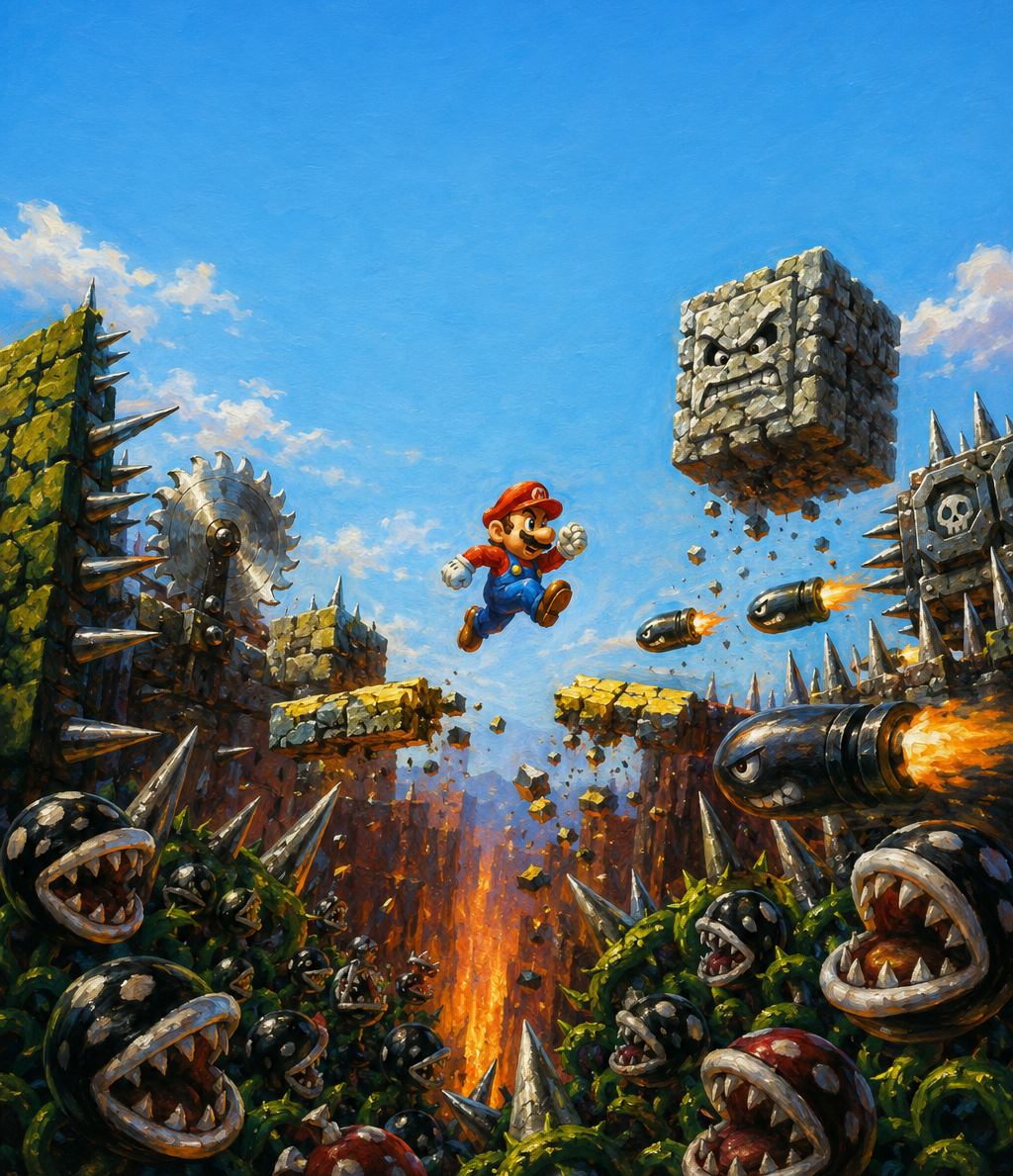
I spend some of my free time dying. More specifically, I play kaizo Super Mario World romhacks, which are fan-made mods of the original Super Mario World, engineered to be brutally, precisely hard. If your reaction to reading that combo of words was, "what the hell is that?", bear with me, this is deep nerd culture. I promise there's a point.
Kaizo (Japanese: 改造, Hepburn: kaizō; meaning "modification", "rebuild", "remodel" or "reconfiguration") is a philosophy of game design, specifically platforming games, distinguished by a high degree of strictness placed upon the player's intended actions and movements through a level. wikipedia
Kaizo levels demand that you die hundreds of times to a single obstacle and consider that a normal Tuesday, but that's also the whole point. I want to talk about why I, a grown man with children of my own, choose to do this voluntarily, and why I sometimes find myself thinking about it in the middle of a workday.
If you've never seen one played, a kaizo level looks vaguely familiar at first, something you might half-recognize as Super Mario World, rearranged into something completely new. Hacks take the Super Mario World base physics engine and build challenges that demand frame-perfect timing, pixel-precise positioning, and inputs chained together with no room for error.
A single jump might require you to release and re-press the jump button on exactly the right frame, bounce off a shell mid-air, and thread a gap that looks impossible until you understand the trick, all in succession with no checkpoints. You are expected to fail, repeatedly, and the failing is the gameplay, not an interruption of it.
Ryukahr makes this look easy, but this is years of mastering the art of kaizo. For further context, I personally have only beaten the first level of the hack he's playing, Grand Poo World 2 by Barbarousking, which is lauded as one of the most difficult kaizo hacks ever created.
The thing newcomers miss is that good kaizo is not random cruelty (again, not all the time). There is a craft to it, a culture, and a strong sense of fairness underneath the difficulty. The unwritten rule is that a challenge has to be readable. The trap should be telegraphed, sight-readable within a handful of attempts, if not the first one. The setup should hand you the information you need to solve it, even if executing the solution takes you fifty or more tries.
Troll-levels and old-school kaizo (now lovingly referred to as "boomer kaizo") have the sole intent of killing you when you least expect it: putting an invisible kaizo block right where you expect to safely jump, leading instantly to your death, or sneakily trapping you in an inescapable box known as a softlock, where your only choice to progress is to die via the timer.
Kaizo level design started as a joke, a meme, schadenfreude, a way to keep playing Super Mario World fresh for us retro gaming nerds. But what evolved from it was a consistent feedback loop that encourages rather than discourages, an surprisingly sophisticated visual design language reinforcing that principle.
A great kaizo level is merciless and completely fair at the same time. It will destroy you, but it will never lie to you. Unless, of course, that is the point.
Here is where my job starts leaking in, and I will keep this light because nobody needs another essay insisting their hobby is secretly a productivity system, but the overlap is real and I notice it more than I expected.
When you die in a well-made hack, two things should happen instantly: you know exactly why you died, and you are back at the checkpoint trying again in milliseconds. No load screen, no ambiguity, no waiting. That tight, honest, immediate loop is the entire reason you improve. You run the experiment, you get a clear result, you adjust, and you run it again, hundreds of times an hour. If you don't understand why, you repeat it over and over again until you do.
Every time I sit down to a development setup where the loop is slow, a build that takes minutes, a test suite that is flaky, an error message that tells me something broke but not where or why - that is the development equivalent of a hidden kaizo block. It kills your progress and never tells you why.
Kaizo is just that principle turned all the way up. The levels that make you better are the ones that answer the question "why did that not work?" instantly and honestly, and so are the tools, libraries, and technologies I choose to solve the problems I face in my work.
The second thing is that fairness instinct, which is a byproduct of kaizo's core gameplay design. A good kaizo level respects the player even while it is busy killing them. It doesn't spring something unknowable on the player and then laugh (unless, of course, that is the point). It gives you what you need to succeed and then asks you to rise to the challenge.
The more I sit with that, the more it sounds like the things I care about in software. A good error message tells you what went wrong and points at the fix instead of just saying something failed. A good API behaves the way its name and shape promise that it will, with no hidden landmines waiting for the unwary caller. Both are forms of the same respect: be honest about what you're offering, and let the difficulty come from the problem itself, never from you hiding the tools to solve it.
Kaizo shows you the carrot, beats you with the stick, and then leaves you holding both. Good software should do the same.
I am not going to dress this up as a life hack. I do not play frame-perfect Mario hacks to become a better engineer, and I would be lying if I told you the two-thousandth death to the same jump felt like professional development. I do it because it is fun...sometimes, because nostalgia is a strong pull to the games I grew up on, and because there is a specific clean satisfaction in saying "FUCK YOU" to the one jump that kicked your ass all week.
The contract a well-designed kaizo level forms with the player is the same one that well-designed software forms with the user:
I, as the designer, am clear about what I am offering, and you, as the user, have all the tools you need to use it without fear, if you want to...or maybe you just die. :)
Will Carter, 2026
If you read this far, thank you! Here's a bonus clip from my Twitch days beating a kaizo level called "1-1 but fast."